The note-taking app for executives
An executive runs from board to interview to client meeting without ever writing. What gets lost is not the conversation, it is the decision. How Sonory makes the written record automatic, without exposing confidentiality.
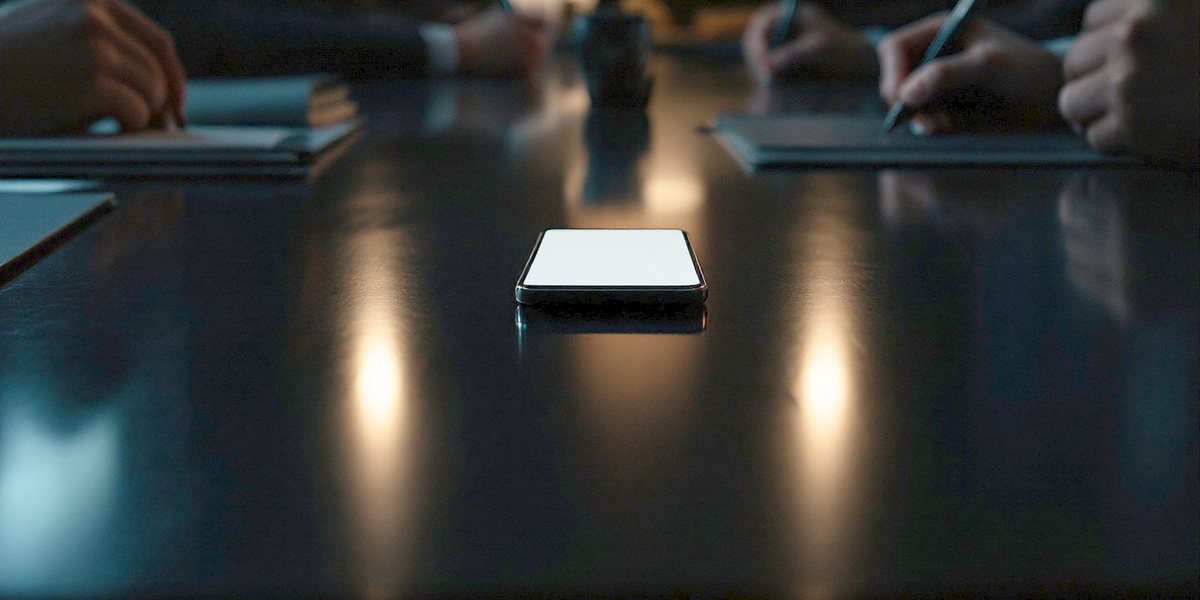
An executive talks all day. Executive committee in the morning, a review with a manager at midday, a client meeting in the afternoon, an investor call at the end of the week. In between, they take no notes. They listen, they weigh, they decide.
This is not carelessness. It is structural: you cannot run a conversation and record it at the same time. Whoever writes drops out, and whoever decides does not write.
What gets lost is not the conversation
The conversation is remembered. What fades is more precise and more expensive:
- the exact decision, with its condition. « We approve the budget, but the two hires freeze until the October review » becomes, three weeks later, « we had approved the budget »;
- who does what by when. The action existed in the room, it never left the room;
- the reservation expressed. Somebody said they disagreed. It appears nowhere, and it resurfaces at the worst moment;
- the figure quoted. Not the one on the dashboard, the one somebody gave from memory and on which the decision turned.
A year later, when it has to be explained why that decision was taken, all that remains are memories that diverge.
Why the usual answer does not hold
Delegating note-taking works, when somebody is free to take them. In a closed committee, a one-to-one, a partners’ call, there is nobody else. And on sensitive matters, adding a third person to the room changes what gets said.
Writing it up afterwards amounts to reconstruction. It takes twenty minutes, it gets things wrong, and it only happens one time in three. The densest meetings are precisely the ones given up on.
Video-conferencing tools transcribe well, when the meeting is a video conference. An executive’s decisions are also taken in an office, in a car, around a table.
What Sonory does
You start the recording with one gesture, you put the phone down, you hold your meeting. At the end you get two things.
The transcript, timestamped, with speakers separated where the language allows. Tapping a sentence replays the audio at that instant: the exact wording stays verifiable, which counts when a disagreement turns on what was said.
The structured note, written from a template. The meeting minutes template produces a one-sentence summary, the list of decisions, the actions with their owner, the open points and the figures quoted. It is not a digest of the conversation in the order it happened: it is what needs to be retained.
The catalogue holds 274 templates across fourteen categories. An executive uses three or four: meeting minutes, interview, sales meeting, and the general template for the rest. You can also create your own, from the reporting structure your organisation already uses.
The question that always comes first
An executive recording a board meeting asks one question before all others: where does this data go.
Recordings, transcripts and notes are stored in Switzerland, in the Zurich region. The processing, however, runs on European entry points: transcription and drafting do not execute in Switzerland, and we prefer to write that rather than round it off. Nothing is sold, nothing is shared for commercial purposes, and your recordings are not used to train models.
Deleting your account erases the recordings, transcripts and notes, not merely the access. The detail is in the privacy policy, in French.
Consent is not a formality
Recording a private conversation without the agreement of those present is prohibited in Switzerland as in France, and criminally punishable. An executive is the last person who can afford to ignore it.
In practice it settles in one sentence at the start of the meeting: « I am recording for the minutes, is that all right? ». The app offers an audible start signal at the beginning of every recording, on by default, and recalls the rule on first use.
Our experience is that the announcement does not get in the way. What does is a recording discovered afterwards.
How to use it without thinking about it
Three habits are enough.
Start the recording before you begin, not when the subject turns interesting. Audio is written to the phone throughout the capture: a network drop loses nothing, and a three-hour recording holds without difficulty.
Choose the template once, the one you use most. You can always generate a second note with another template on the same recording, without recording again and without spending your transcription minutes twice.
Read the note, not the transcript. The note runs to a page, reads in two minutes, and will be enough nine times out of ten. The transcript is there for the tenth.
What it changes in practice
The minutes go out the same day, not the following Friday. Actions carry a written owner, which makes follow-up possible. A year on, the decision and its condition are findable in seconds. And two-person meetings, the ones never minuted for want of a scribe, finally leave a trace.
The free tier opens 45 minutes a month, enough to judge on your own meetings rather than on a demonstration.